Debacle Prevention
Here’s a daunting question: Why does damn near every technology project end up as a complete debacle? Of course it never starts out that way...
Here’s a daunting question:
Why do most technology projects end up as complete debacles?
It never starts out that way. A highly qualified expert firm or consultant is brought in. Staff and leadership get seated around the table. Budgets are allocated. Optimistic kickoff meetings are held, with reassuring powerpoints and timeline charts. Months of meetings are scheduled. Projects are managed.
Yet somehow, reliably, the result is disappointing if not disastrous. And it’s usually a catastrophic waste of time and money. Whether it’s an outright debacle or a mishmash of partial victories, it’s a tragic missed opportunity to harness the game-changing potential that was envisioned in the first place.
This just isn’t right. You’re doing mission-oriented, heroic work. Technology should be supercharging you, not pulling you backwards.
So how can this be prevented?
The answer is simple but profound. It’s about consistent, detailed, strategic ownership and leadership, inside the organization’s walls. That is the business of debacle prevention.
And what does ownership really mean? It means someone who is paying attention to every single detail. Who is constantly making strategic and tactical adjustments. Who is seeing the project through from all angles, all day, every day.
It means having access to, communication with, and mutual respect from leadership and staff around the organization. It means knowing what to outsource and what to insource. It means constantly prioritizing and re-prioritizing based on the most updated landscape. It’s knowing which deadlines are real, and when it makes sense to extend timeline or cost restrictions in exchange for a game-saving fix or a game-changing upgrade.
That kind of internal ownership and leadership is the real gamechanger. You can have the best external consultants in the world, and they won’t deliver on your project’s potential if no one at your organization is playing close, daily attention. How could an external firm ever possibly fill that role?
You, as an organization, must have or develop people -- thoughtful, skillful people -- who are empowered to understand and guide the direction of development, and whose role it is to guide these processes persistently and patiently until they are completely landed. With massive amounts of flexibility, humility, and caring.
It’s a serious endeavor and there’s no quick fix, but it is most certainly possible. It takes time, money, care, and a steadfast commitment to an entirely new way of doing things. One that refuses to accept further debacles as a given, or even an option.
Expect More
“Ugh, I hate our technology.” How often do we hear this? How often do we say this? Can we really afford that expectation?
“Ugh, I hate technology.”
How often do we hear this? How often do we say this?
It’s almost a given, something we can share an eyeroll about at the coffee machine. Most of us almost expect to struggle with technology.
Can we really afford that expectation? Technology is probably at the very center of how we effectively deliver, track, and measure our programs these days.
Imagine being a race car driver with an engine that is malfunctioning and slowing you down. And imagine that you just accepted that as normal and kept trying to race.
We can no longer afford to expect -- and allow -- our technology to be subpar. The first step to building and managing an effective technology landscape is raising our expectations.
Consider this simple statement:
Your organization’s technology should work, and it should provide you value.
Can you say that about your organization? It’s not too much to ask. Let’s stop viewing dysfunction as normal. Let’s start expecting more, and putting in the work to make it happen.
You Need a Product Team
The only way for technology to thrive is with a specialized, holistic and ongoing focus. Without that, organizations predictably lurch from debacle to debacle, with technology as a hindrance to their effectiveness rather than a supercharger.
We’ve reached an era where high-quality technology offers unprecedented ability to superpower work and increase overall effectiveness. But the only way for technology to thrive is with a specialized, holistic and ongoing focus. Without that, organizations predictably lurch from debacle to debacle, with technology as a hindrance to their effectiveness rather than a supercharger.
A product team uses methods of “product management” that have solidly emerged as best practices in the tech world. At its heart it recognizes two simple ideas: We now have a new layer of technology “products” to manage (such as website platforms and databases), and those products require a dedicated, internal team with the clear mission of strategically driving and guiding your investments in those products.
Let’s take a common example. Say you engaged a firm to set up a new CRM for you. They gathered requirements, customized the database, and even did a couple trainings for your staff. They probably did a solid job of it. So as time goes on why does the system reliably get more frustrating instead of less?
It’s because platforms such as CRMs can go any direction you need them to. This is an incredible strength and a potential game-changer for your efficiency and overall workflow. But developing a roadmap for them requires careful, thoughtful, dedicated management and stewardship, inside your organization’s walls.
So when that new CRM is launched, a product team recognizes that moment not as the finish line, but as the starting line. Their job is to make sure everyone knows how to use that system, and to constantly be on the lookout for potential improvements, and to manage and resolve competing priorities, and to be generally in a never-ending quest for increased efficiency and improvement. They are your organization’s dream team of technology problem-solvers, turbochargers, and fairy godmothers, constantly swooping in to make everything better.
But getting there means admitting that it simply doesn’t work to ask other types of staff to manage technology off the sides of their desks. Nor does it work to just outsource everything tech-related, or to ignore our technology altogether because everyone is too busy trying to do their “other” jobs. We need skilled people in place whose job it is to ensure your technology is fully aligned with what you’re trying to accomplish and creates the high quality experience you want to deliver.
The good news is, the product team structure is actually not that complicated or that hard to implement, and it scales way up and way down. Perhaps counterintuitively, we’re not talking about hiring a bunch of highly skilled coders and developers. It’s much more about dedicated internal staff whose job is to deeply understand the business needs and the way the technology will meet those needs.
So at its most basic, a product team consists of a “product manager” for each of your essential tech platforms, with clear processes and principles to guide their work. You also likely need a chief to help guide and direct, and to sit at the executive table to strategize, give real time assessments of what’s possible when, and help navigate priorities and capacity in harmony with the rest of the organization.
If you are larger, there will be more demands on your product team, and you are wise to invest further in product staff so they that can focus their energies on the force-multiplying effects of products that are well considered, well architected, well tested, and well explained throughout your staff.
You likely even have some of the necessary talent inside of your organization already, whether you realize it or not. Notably, the product manager role is more of a tech strategy role than anything very technical, so you’re still working with external specialists when it comes to specialized work such as designing and developing.
Fundamentally, the product team represents the acknowledgement that, among a landscape of many things that can be outsourced, you simply cannot afford to outsource the brains of your technology operation. Your technology backbone is too essential and too unique to your organization, and a cookie cutter approach won’t get the job done.
Of course, change can be hard. In many cases this is an entirely updated way of thinking and working, and it may cause some friction for people who are attached to the old way. But once an organization implements a product approach, it can be hard for them to understand how they ever survived without it.
You Don't Want a Treasure Map
You don’t want a treasure map. You want your own team of ace treasure hunters.
People often seem to wish that technology could be an afterthought. Isn’t there a pill they can take so the headache goes away? Or a consultant who can just take care of it? Can’t someone just give me a treasure map with an "X" showing where I should dig?
But in reality you don’t want a treasure map. You want your own team of ace treasure hunters.
Why? Because a treasure map assumes that the treasure will remain in a specific place, and the path to get there will look the same tomorrow as it does today. That may be the case for buried treasure. But in the case of technology, neither of those assumptions are true. Your treasure is constantly moving, and the landscape around it is constantly changing. So the treasure map you create today is almost guaranteed to miss the mark within even a few months. And if the map is all you've got, then you're stuck.
What you actually need is your own team of treasure hunters, strategic and skilled enough to assess and reassess the terrain as your journey evolves. A leader who can take in the landscape, your team's skills and supplies, your organization's restrictions and priorities along the way, and adjust those priorities and destinations appropriately. A skilled team that can communicate and manage and execute and delegate. That's how you'll reach your next destination safely, and the destination after that, and the one after that.
An over-simplified treasure map handed to you may seem like an attractive option, especially since the investment to get there is relatively limited. But in reality it's a cheap shortcut to the real work of building internal capacity and self reliance. And it's wildly inadequate insurance against the changes guaranteed to come. The only reliable insurance is skilled guidance and stewardship that you're confident can adjust to the ever-changing road ahead.
Continuous Investment and Smiley Faces
Our most popular chart boils down the hazards of uneven technology investment into a simple graph of smiley faces, showing the benefits of a continuous investment cycle.
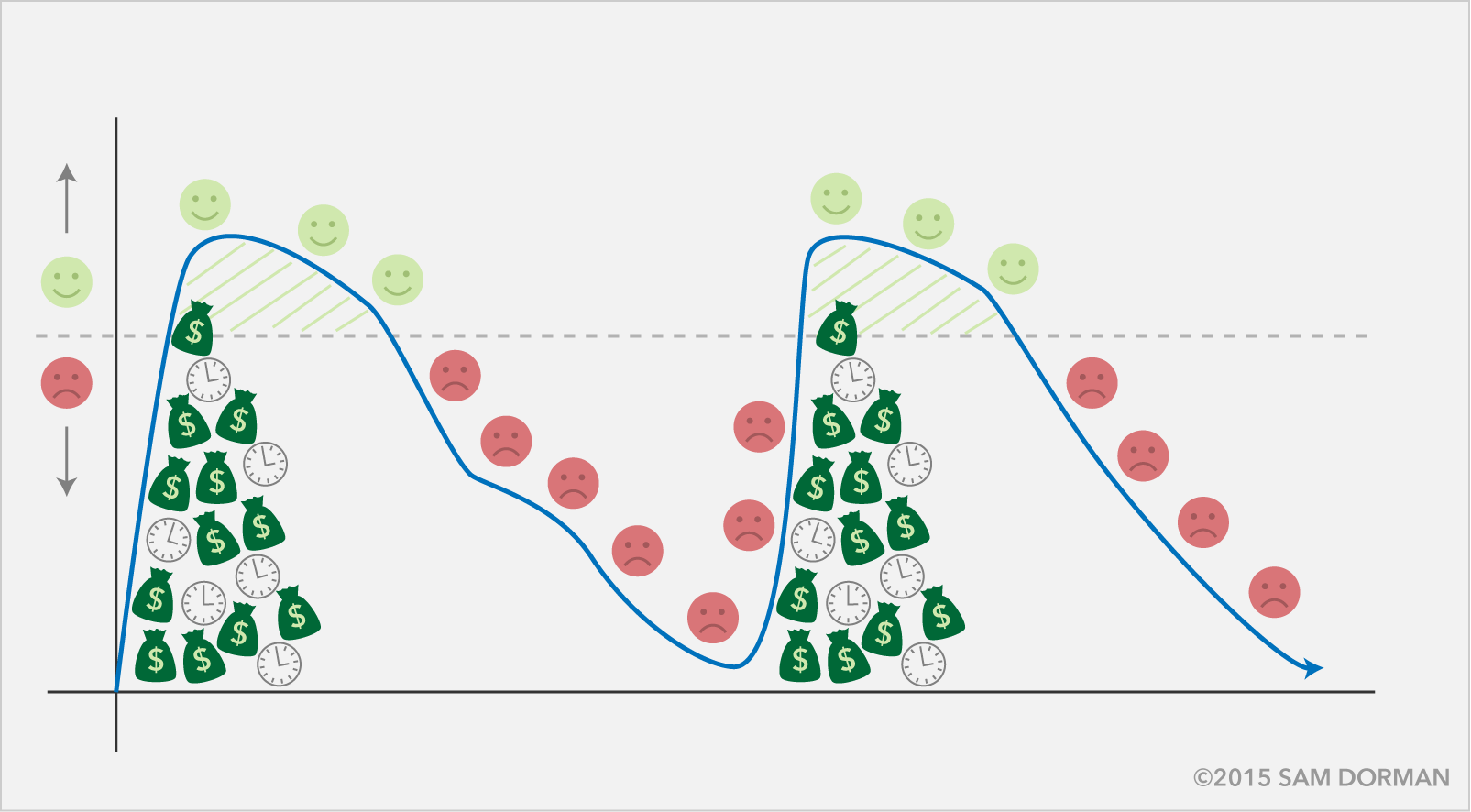
An organization decides it’s time for a new website. All of the stakeholders get involved, bring in a skilled external firm, and together they figure out the strategy, content, messaging, and style.
The site then launches to great fanfare, and everyone loves it. On day one it’s the bold new face of the organization.
But if you check back in one year later, the grumbling has started. By Year 3, everyone talks about how terrible the website is. And by Year 5 it’s universally considered a complete embarrassment. So it is torn down and rebuilt from scratch.
And the cycle repeats itself.
The same could be said for almost any digital product. In fact, it's a cycle we’ve all gotten so accustomed to, it can be hard to remember how broken it is.
We got to wondering why this kept happening. Why, in Year 3 or 5, did everyone hate the exact same website that they loved on day one? Why did everyone’s opinion change when nothing about the site had changed?
Of course, that's the very problem. Five years after it launched, nothing about the site had changed.
Meanwhile the entire world had changed around it. The organization changed and their needs for a website had changed. Website styles had changed, so a five year old ago site looked hopelessly dated. The technology underneath it had changed, from platforms to security and speed. The expectations of users and accepted standards of the internet had changed.
And all the while the site was stuck in the ancient world it was created in, even just five years ago.
Consider what an atrociously bad return on investment this is, for something as essential in this day and age as your website. Notice how briefly you’re in the green smiley face zone. In other words, despite all of the money and effort spent, your site is delivering on its potential for a miniscule amount of its lifecycle.
By contrast, what does a product-centered, ongoing-investment approach look like?
Well, you still have to spend the time and money to build a site in the first place. But importantly, that becomes the starting line rather than the finish line. Once the product is built you continue paying attention and investing on an ongoing basis. You admit that the site needs to continue to evolve in order to stay relevant, useful, and effective. But with that cycle of continuous investment, you manage to keep everything in strong working order.
Behold the profusion of green smiley faces.
Yes, that cycle goes on forever. And yes, it costs money. But look at the comparative return on investment. You are devoting the focus and resources required for the product to deliver on its promise, to be effective for your staff, your constituency, and for delivering on your mission.
And what could possibly be a better investment than that.
You're a Tech Company
Whatever you do nowadays, you’re also a tech company. Let's admit that, and then put good people on delivering it.
Lyft and Uber are tech companies. That's obvious, right?
But are they really? What do Lyft and Uber really do? They’re taxi services, shuttling people in cars from one location to another. What’s so tech about that?
The answer is that their entire business depends on the consistent, high-quality function of a technology product. If their apps and systems don’t function consistently, at a high level, the whole thing falls apart. If they’re not constantly paying attention to what is working well and what needs to be improved, they will fall behind.
We would argue the same is true nowadays for just about every organization or business of any kind. What modern-day mission can be realistically accomplished without the high quality function of a technology backbone?
And guess what tech companies do that we all need to be doing? They care enough about tech to resource it with a robust team of smart people. It doesn’t happen by itself.
Whatever you do nowadays, you’re also a tech company. Let's admit that, and then put good people on delivering it.
Building Rocketships
When you build a culture of smart technology, you’re building your organization a rocketship. Once you’ve seen this potential, you realize there are corners you should never cut.
If you’re harnessing the opportunities that technology truly offers, it's not just about barely surviving. It's about raising your game to new levels where your technology starts to enable your organization to transform itself on a regular basis.
Your staff is spotting efficiencies, grasping unseen opportunities, testing new ideas, optimizing, experimenting, and learning. That’s the real north star. That is when your organization’s technology is no longer about trying to fix leaky pipes.
When you build a culture of smart technology, you’re building your organization a rocketship.
Once you’ve seen this potential, you realize there are corners you should never cut.
What’s the purpose of a rocketship? To get you somewhere ambitious, to carry out your mission, and to come back alive. That’s true of your organization, too, isn’t it?
You don’t need gold plated gear shifters, you don’t need Corinthian leather seats, but you do need a thoughtfully architected, exactingly built ship, and every piece of essential functionality tested by highly capable staff for a thousand different conditions.
If your systems and technology are really unimportant enough that you plan to outsource the whole thing, barely pay attention, cut budgets, limit staff time, or rush things that deserve careful attention, you might need to consider getting out of the space travel business. You won’t be able to compete. Maybe look into building a go-kart instead.
Otherwise, if you're looking to travel to grasp the unlimited opportunities of technology space travel, you need to invest seriously in the effort, and to pay serious attention at every step along the way. Be smart about your investments and leave those corners intact.
You Can't Delegate Caring
You’re an organizational leader. The demands are on you are high and the pace is fast. You simply must delegate things in order to survive, and for everything to get accomplished. But one thing you cannot delegate is caring about your technology. Your organization, all the way to the top, has to care.
You’re an organizational leader. The demands are on you are high and the pace is fast. You simply must delegate things in order to survive, and for everything to get accomplished.
But one thing you cannot delegate is caring about your technology. Your organization, all the way to the top, has to care. It’s simply not good enough to say “I don’t really get technology, but you guys go ahead and take care of it.”
Why? Because your tuning out causes a ripple effect down through the organization that ultimately drains essential focus and resources from where it needs to be. Maintaining strong and high-quality technology is a detailed, never-ending process that demands constant vigilance and thoughtfulness, not to mention time and resources. If you communicate that you care about other priorities more, your organization will act accordingly.
But your technology has a fundamental, critical impact on your success. It’s what’s going to let your staff work faster and smarter. It’s going to offer you data on what’s working well and where improvements are needed. It’s going to be your arsenal for smart ways to engage your public.
It’s your job to understand the strategy and knowledgeably help guide the possibilities. You need to understand the nature of your platforms enough to know -- at least on a high level -- what’s easy, what’s possible, what’s expensive, and what isn’t really viable right now. You simply have to understand where it stands and where it’s capable of going. You must care about it.
You wouldn’t tune out when it comes to raising money, to strategic planning, to how your program is run, to selecting your board, to developing marketing campaigns, or to revising your branding and messaging. Of course not. Those things are too essential!
If you stop to think about it, hopefully it becomes equally obvious that your technology is too essential to ignore as well.
Organizations take on the character and priorities of their leadership. If you want your organization to care about technology in a detailed, robust enough way to be great at it, that level of caring starts at the top, and cannot be delegated.
Are We Too Small for This?
Does this product team model scale down for smaller organizations? Here’s one way to look at it. Chances are that for an organization or company being founded today -- especially a startup run by younger entrepreneurs -- a technology leader is either a co-founder or the very first hire.
Does this product team model scale down for smaller organizations?
It's a fair question.
Here’s one way to look at it. Chances are that for an organization or company being founded today -- especially a startup run by younger entrepreneurs -- a technology leader is either a co-founder or the very first hire.
Why would that be?
Because for people who have grown up around tech it’s intuitively obvious that technology will be an essential part of successfully delivering their impact or services.
“Oh,” you say, “that doesn’t really apply to us. Our program happens entirely offline in the real world.” Are you sure it doesn’t apply? How do you track your program and constituents? Communicate with the public? Raise money? Evaluate your effectiveness?
When we talk about young entrepreneurs today, we’re not just talking about people who are creating apps. We’re talking about anyone in today’s landscape who is trying to do high quality work, optimize their effectiveness, and compete for hearts, minds, and eyeballs.
So yes, the model scales down. All the way down to an org size of one or two.
If you look at your smaller-size organization with fresh eyes, what’s the maximum size of a team you can really justify before you include a skilled technology leader in the mix?
Three? Maybe four? Seven?
Are you sure about that?